Search the site:
 go search this site

WELLINGTON - P55

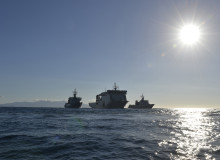
WELLINGTON arrives at Devonport Naval Base

The Offshore Patrol Vessels (OPVs) HMNZS OTAGO and WELLINGTON deliver substantial new capability to the Royal New Zealand Navy.  The ships can go further offshore, stay at sea longer, and conduct more challenging operations than the Inshore Patrol Vessels, and will enable the RNZN to conduct patrol and surveillance operations around New Zealand, the southern ocean and into the Pacific.

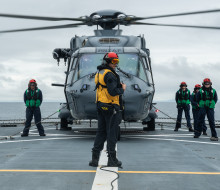
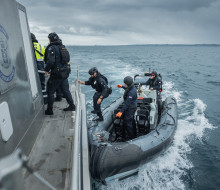
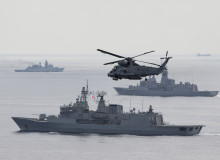
The OPV’s are capable of many roles including maritime patrol, surveillance and response.  They have the ability to conduct helicopter operations using a Seasprite SH2G helicopter, boarding operations using the ships Rigid Hull Inflatable Boats, or Military Support Operations with embarked forces.

The OPV’s have strengthened hulls which enable them to enter southern waters where ice may be encountered.  They are not designed as ice-breakers or to enter Antarctic ice-packs, but have the range and capability to undertake patrols in the southern ocean where ice may be encountered.

The ships are highly automated and operate with a core crew of 35, plus 10 flight crew to operate a helicopter.  The ships power and control systems are fully computerised.

Specifications:

Standard Displacement: 1,900 tonnes
Length Overall:             85 metres
Beam:                         14 metres
Range:                        6,000 nautical miles
Maximum Speed:         Maximum continuous 22 Knots

Complement :  
Core ships company      35
Flight personnel             10
Government agencies:   4
Additional personnel:     30
Total:                           79

Armament:                   One 25mm Bushmaster Naval gun and two .50 calibre machine guns.

Helicopter capability 

Wellington can embark the KAMAN SH-2G (NZ) Seasprite helicopter onboard.

 
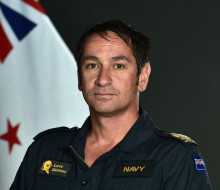
LT CDR Phil Rowe
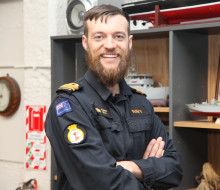
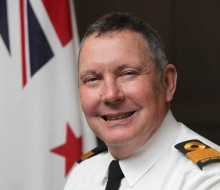
Above: LT CDR Philip Rowe, Commanding Officer HMNZS WELLINGTON.  To read LT CDR Rowe's biography, click here.

The role of the Offshore Patrol Vessels

WELLINGTON will be able to operate throughout New Zealand’s 200 mile Exclusive Economic Zone (EEZ), the southern ocean and the Pacific.  She will carry out a range of roles including patrolling, surveillance, search and rescue, humanitarian assistance, disaster relief, support to peacekeeping operations and sea training for the Navy. 

WELLINGTON will conduct maritime patrols in conjunction with the P-3 Orion maritime patrol aircraft in the New Zealand EEZ, southern ocean and South Pacific.  The surveillance tasks are primarily non-military in support of civilian agencies and involve specialist staff from government agencies such as NZ Customs and Ministry of Fisheries.

Multi-Agency Operations and Tasking (MAOT).  

The OPVs will be available to support Government Agencies including:

a. New Zealand Customs Service.
b. Ministry of Fisheries.
c. New Zealand Police.
d. Maritime New Zealand.
e. Ministry of Foreign Affairs and Trade.
f. Department of Conservation.
g. Ministry of Agriculture and Forestry.
h. New Zealand Immigration Service.
i. Department of Prime Minister and Cabinet.

Patrol/response capability

The patrol and response capabilities of the OPVs include:

a. Maritime counter-terrorism.
b. Surveillance and Reconnaissance.
c. Surface contact detection, identification, interception and boarding.
d. Helicopter operations including surveillance and reconnaissance, and surface contact detection, identification and interception, and support to boarding operations as well as general personnel and stores movement.
e. Apprehension and escort of vessels.
f. Pollution control.
g. Maritime Search And Rescue (SAR), including aid to vessels in distress (including towing of vessels of same or smaller size).

 Secondary roles for the OPVs

In addition to their patrol and response capabilities, the OPVs are capable of secondary roles in support of the Navy, NZ Defence Forces and Government.  These secondary roles include:

a. Provision of support to embarked military forces, e.g. transportation, insertion and extraction of military units and their associated equipment.
b. Disaster relief operations in NZ and beyond if required.
c. Defence aid to the civil community.
d. Medical Evacuation (Medivac).
e. Military Hydrography.
f. Diving Operations Support.
g. Mine Countermeasures Support.
h. Collection of environmental data. 
i.   VIP Transport, and; 
j.   Defence Diplomacy and Representational activities in NZ and foreign ports.

HMNZS Wellington's crest.

The Badge and Affiliation of WELLINGTON

WELLINGTON's Badge is the same as the decommissioned HMNZS WELLINGTON Leander class Frigate.

Originally it was intended to hold a competition to produce a design for the badge of HMNZS WELLINGTON, a Leander Class Frigate, along with that of SOUTHLAND. The Admiralty agreed, however, that the badge and battle honours of HMS WELLINGTON, a Grimsby Class sloop, which had been named after the capital city and was based in New Zealand during the 1930's, could be used by the Royal New Zealand Navy.

Despite the fact that the ship had an existing badge, there was some discussion about the actual colours that would be used. This was primarily because of the fact that, although the dolphin and mural crown were taken from the Coat of Arms of Wellington City, the colours were not the same as those used in the Royal Badge. The existing badge showed a blue and gold dolphin and a gold mural crown on a white field, while the city crest consists of a blue and gold dolphin and a silver crown. This discrepancy probably arose because the badge was taken from the Coat of Arms of the city in use at the time the badge was approved in 1933, although Wellington was not formally granted Arms until 1951. The main difference was in respect of the colour of the crown - in the RN badge it was gold, while in the city Arms it is now silver. This caused difficulty with the background, silver essentially being white in heraldry.

It was decided that the crown would be silver in keeping with the city Arms and that the background would therefore be red, the principal colour of the Shield of Arms. Once this was decided, the production of a colour master drawing was undertaken by Squadron Leader R.M. Conly, the official Artist of the Royal New Zealand Air force. 

The building of WELLINGTON

WELLINGTON is the second Offshore Patrol Vessel to be built for New Zealand.  Modules of the ship were built separately, including some in Whangarei, to be assembled at the Tenix shipyard, Williamstown, Australia.  The ship is based on a design already in service with the Irish Navy and Maritius Coastguard.  

WELLINGTON will be affiliated with the Wellington region of New Zealand; her home port will be Wellington.

Copyright © 2013 Royal New Zealand Navy | RSS Feeds | Help | Legal Notices | Feedback |  newzealand.govt.nz